Introducing Five PR Lanes: The Field Guide to AI Search Visibility for Brands in food, beverage, health, and wellness.
By Len Cercone, Founder and CEO, CerconeBrownCompany (CBC PR)
Estimated reading time: 6 minutes
The 89% stat is everywhere now. Earned media drives AI citations. It’s in agency decks, client briefings, and conference keynotes across the PR and marketing industry. Here’s the dirty truth: almost nobody has figured how to actually do it.
That’s not a knock on the people citing it. The problem is structural. AI-powered search is evolving fast enough that understanding how it actually works — which publications carry citation weight, how message architecture compounds over time, why one great placement isn’t enough — requires time that most practitioners running accounts, serving clients, and managing the daily demands of the work simply don’t have.
We made a deliberate decision to take that time. Several months out of the trenches, with our team, to study the data, test the methodology, and build something practitioners could actually use. What came out of it is Five PR Lanes: The Field Guide to AI Search Visibility in Food, Health & Wellness — a free field guide detailed enough to execute without outside help. This is full of best practices for increasing brand visibility in AI-generated search results
Here’s a preview of what’s inside.
The problem isn’t one great placement. It’s the absence of five coordinated ones.
Len Cercone, CBC PR
Lane 1 — Media Relations: Not all outlets are equal, and prestige isn’t the right measure.
Tiered prestige doesn’t always match AI citability. A Healthline article that’s freely accessible, medically reviewed, and structured around the questions consumers actually ask often drives more AI visibility than a glossy profile behind a paywall. In food, health, and wellness, the outlets that matter most for AI citations — Healthline, EatingWell, Verywell Health, mindbodygreen, Bon Appétit — share a set of characteristics: structured, expert-attributed, open-access content that genuinely informs. The guide maps the publications by category and explains what makes them work.
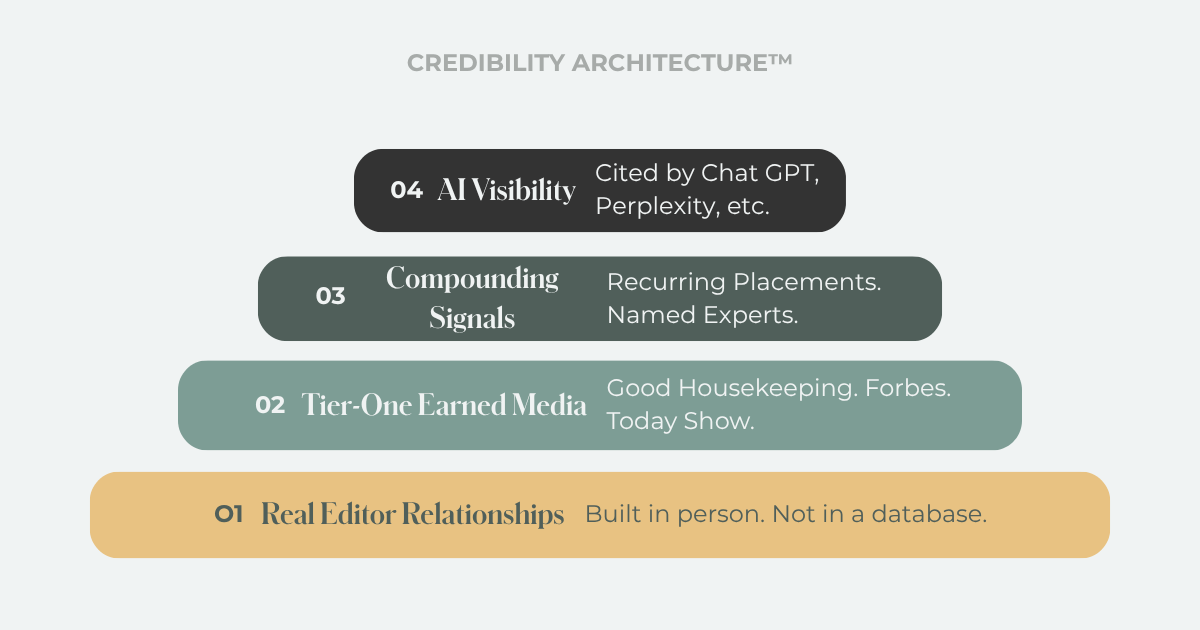
AI platforms like ChatGPT, Perplexity, and Google AI Overviews don’t rank pages. They build consensus — synthesizing answers from five to ten sources per response. A brand wins an AI answer when its message is corroborated across multiple independent sources, not when it appears in a single impressive outlet. One placement is a data point. Five consistent ones are a signal.
Lane 2 — Thought Leadership & SMEs: Credentials outperform titles every time.
AI models track entities — including people. A registered dietitian appearing consistently across media placements, LinkedIn, and creator content builds an authority signal the model associates with your brand. A VP of Marketing, regardless of how smart or articulate, can’t do what a credentialed expert can here. If you don’t have that expert in-house, formalizing an advisory relationship is worth the investment.
Lane 3 — Creators & Influencers: Depth beats reach.
A five-minute YouTube video where a nutritionist genuinely explores your category generates more AI signal than a thirty-second sponsored shoutout. AI models cite content that informs. They ignore content that sells. Brief creators the way you’d brief a journalist: category context first, brand second.
Lane 4 — Company Content: Most brand sites are built for conversion. The ones winning AI answers are built for trust.
Your owned content is the one lane where you control the message entirely. Lead with the answer in the first two sentences. Structure pages around the questions consumers actually ask. Name the expert who authored or reviewed the content. Match the language your earned placements use — consistency between owned and earned is itself a corroboration signal.
Lane 5 — Measurement: You can’t optimize what you don’t track.
Most brands don’t know where they stand in AI answers. Start with a one-hour audit: ask ChatGPT, Perplexity, and Google AI Overviews the ten questions your customers ask most about your category. Screenshot the results. Note which brands appear, which publications are cited, and whether your messaging shows up at all. What brands find, almost every time: a competitor has started building signal in the exact white space they thought they owned.
The full guide walks through each lane in detail — which publications to target by category, how to build message architecture before any pitch goes out, how to brief creators for AI relevance, and how to track citation share over time.
It’s free. Use it.
Download Five PR Lanes: The Field Guide to AI Search Visibility →
A: AI search visibility is the likelihood that your brand appears in answers generated by tools like ChatGPT, Perplexity, and Google AI Overviews. As consumers increasingly use AI to research purchases — “what’s the best probiotic,” “is collagen worth it,” “top clean beauty brands” — appearing in those answers has become as strategically important as ranking in traditional search results.
A: Research from Muck Rack shows that 89% of AI citations originate from earned media. AI platforms synthesize answers from multiple credible sources, and the publications your PR program targets — Healthline, EatingWell, mindbodygreen, Verywell Health — are among the most frequently cited in food, health, and wellness AI responses. A strong earned media program, built around consistent messaging and credentialed experts, is the foundation of AI citation authority. Another great resource is Outcomes Rocket AI’s Sources of Truth study.
A: AI platforms build consensus — synthesizing five to ten sources per response and rewarding brands whose core message appears consistently across multiple independent outlets. A single placement is a data point. The same message appearing across earned media, expert content, creator coverage, and owned channels becomes a signal AI treats as authoritative.
A: The outlets AI engines cite most in these categories include Healthline, Verywell Health, EatingWell, mindbodygreen, Bon Appétit, WebMD, and Harvard Health Publishing. These publications share common characteristics: freely accessible content, expert attribution, structured formats, and editorial standards AI models associate with credibility.
A: Start with a one-hour audit. Ask ChatGPT, Perplexity, and Google AI Overviews the ten questions your customers ask most about your category. Note which brands appear, which publications are cited, and whether your brand’s core claims show up anywhere in the answers. Most brands find a competitor has already begun building signal in the exact white space they thought they owned.
A: Five PR Lanes is the earned media methodology CerconeBrownCompany (CBC PR) built to help food, health, and wellness brands build AI citation authority. It coordinates five areas of a communications program — Media Relations, Thought Leadership, Creators & Influencers, Company Content, and Measurement — so each lane reinforces the others and builds the multi-source presence AI platforms treat as authoritative. The full framework is available free at cerconebrown.com/ai-visibility.
Len Cercone is the Founder and CEO of CerconeBrownCompany (CBC PR), a consumer lifestyle PR agency focused on food, health, wellness, parenting, lifestyle, and clean beauty since 2001. CBC’s HOUSE Programs provide unmatched access to the editors whose publications AI tools cite most. Learn more at cerconebrown.com/ai-visibility.
- Culinary House East: A Taste of Fall in Stowe
- Why October 15 Is the New Black Friday Deadline
- Health House East: Where Wellness Took Center Stage
- We Stepped Out of the Trenches to Figure Out AI Visibility for Brands. So You Don’t Have To.
- What AI Visibility Means for Food, Health, and Wellness Brands — and What Your PR Program Should Do About It