Key Takeaways:
- Credibility is now a growth lever, not a PR outcome. AI and modern platforms prioritize expert-backed, earned, educational content—making credibility a direct driver of visibility, trust, and performance.
- Brands must actively manage how AI understands them. Without structured expertise, proof points, and authoritative voices, AI will elevate competitors as category leaders instead.
Estimated reading time: 6 minutes
AI has changed how consumers discover, evaluate and trust brands. It has also changed how content is ranked, cited, and surfaced across search, social, and increasingly generative AI platforms.
But here’s the part most marketing leaders haven’t internalized yet:
Your brand’s credibility is no longer determined only by what you publish, but also by what AI thinks is credible about you.
Consumer trust is shifting. AI systems are rewriting the rules of visibility. And the brands that grow in the next decade won’t be the loudest — they’ll be the most useful, verifiable and trusted. This is why consumer brands need to operationalize something new: Credibility Management.
Not reputation management. Not classic PR. A modern, AI-era discipline built around one goal:
Ensuring your brand and leaders are findable, trusted, and referenced in the places humans and AI systems look for authoritative answers.
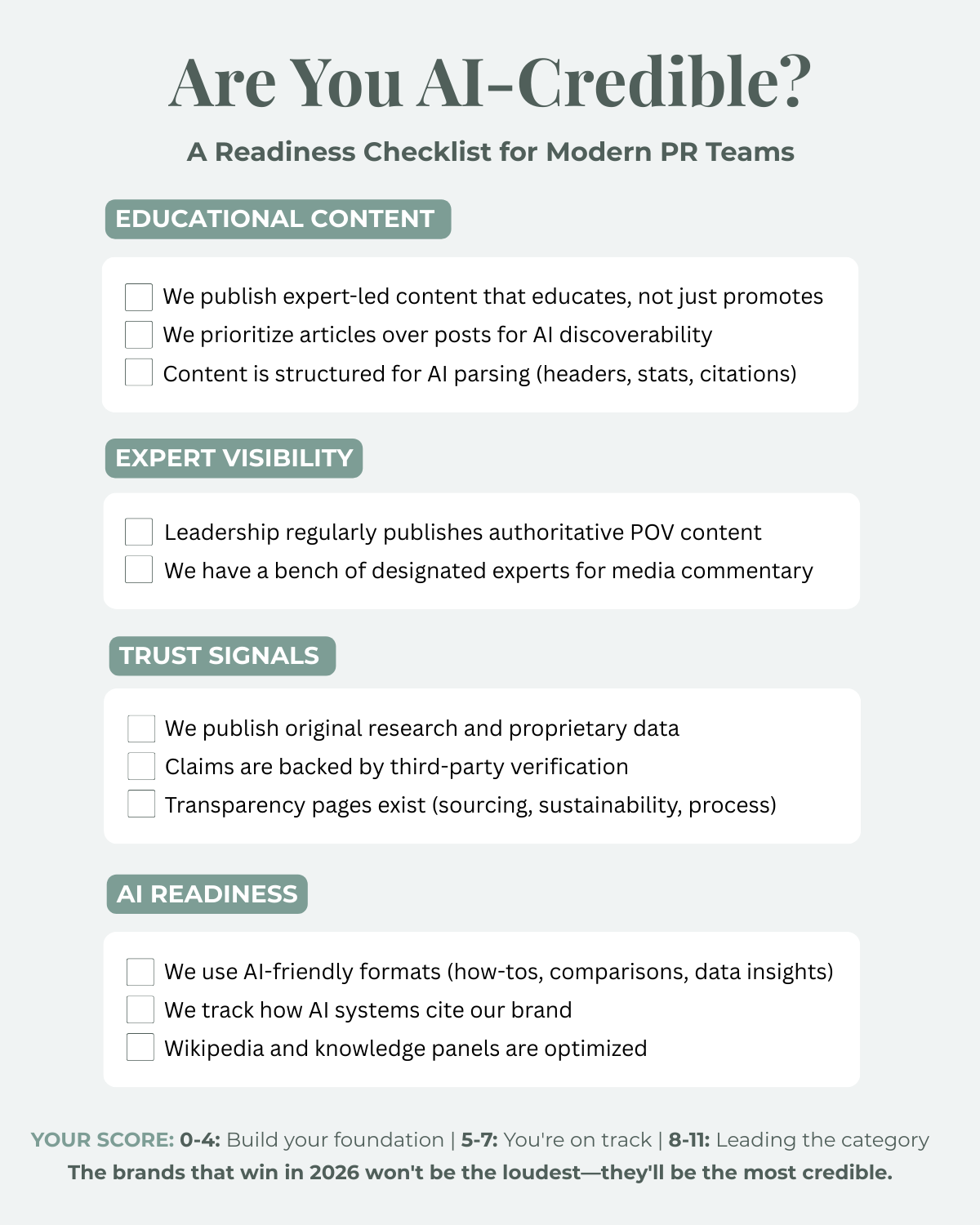
Why Credibility Is Now a Performance Metric (Not a PR Metric)
Several converging trends are pushing credibility to the center of brand growth:
AI tools reward trustworthy, educational content—not promotional content.
AI tools generate their responses based on initial training data and real-time searches of web content. When choosing which sources to cite, the AI models are prioritizing content they deem trustworthy – which is overwhelmingly earned media. According to Muck Rack, 89% of citations come from earned media and 27% come from journalistic content.
Platforms like LinkedIn have also overhauled their ranking engines, replacing old signal-based algorithms with large language models that evaluate the quality, clarity, and usefulness of content (Trust Insights, The Unofficial LinkedIn Algorithm Guide, Fall 2025 Edition).
This means your brand gets visibility only if you are contributing real expertise to the ecosystem.
Generative AI increasingly determines what people see.
MuckRack’s new “What is AI Reading?” dataset shows:
- More than 95% of links cited by AI are from non-paid media. Removing owned, more than 89% are from earned media.
- Articles, not posts, drive citations on LinkedIn (46% vs. 1%)
- AI references process- and concept-level Wikipedia pages more than brand pages
Translation: AI systems reference structured knowledge, authoritative sources and educational content — not marketing campaigns.
Consumers trust experts, not brands.
In the Washington Post’s analysis on AI accuracy, medical answers varied widely by model — and only the AI tools that cited the newest, expert-driven clinical guidance were considered trustworthy.
For categories like health, parenting, nutrition, wellness, home and sustainability , expert-backed content isn’t optional. It’s the barrier to entry. This is why brands must architect their digital presence in a way that signals authority to both humans and algorithms.
What Is a “Credibility Management” Program?
At CBC PR, we’re helping consumer brands build a structured, operational system that ensures their expertise is visible, trustworthy and AI-ready. A strong program includes five pillars:
1. Educational Content Architecture
Educational content outperforms promotional content across the funnel:
- +131% higher purchase likelihood immediately after reading education (Conductor)
- +22% improvement in product retention (Intellum)
- +35% increase in LTV (Check n Click)
Today, education isn’t a content tactic — it’s the most scalable brand differentiator. A credibility program designs a structured journey from:
Unaware → Problem aware → Solution aware → Brand credible → Ready to act
2. Executive & Expert Visibility System
Consumers trust people more than brands. AI tools trust subject-matter authority more than campaign messaging. We build:
- Executive POV platforms
- Expert-led LinkedIn articles (important now that articles drive 46% of citations)
- Commentary systems that feed credibility signals into the AI ecosystem through bylines and pitching key trade publications
- “Ask the Expert” editorial formats optimized for generative search
3. Generative Engine Optimization (GEO)
SEO is now GEO — Generative Engine Optimization. It’s time for all PR folks to nerd out by wading into SEO, at least enough to understand how to structure content for easy AI visibility. This means:
- Structuring content so AI can parse and cite it
- Publishing in formats AI values (articles supported with statistics and expert quotes, explainers, comparisons, listicles)
- Using newswire services like GlobeNewswire when AI citation matters
- Creating high-quality, entity-rich pages that model knowledge structures used by AI
4. Trust Infrastructure & Proof Points
To be credible in an AI-driven world, brands need evidence, not adjectives. This includes:
- Original research and consumer insight studies
- Expert citations and peer-reviewed content
- Transparent sustainability or ingredient sourcing
- Third-party claims verification
- Real-world case studies and product performance data
AI tools heavily favor structured, verifiable facts, not unsubstantiated messaging.
5. Reputation Monitoring & AI Risk Management. This is where traditional PR meets new AI requirements. But PR people have been using these assets for years. We just called it crisis management. Again, this hasn’t changed, but how we use it in the age of AI has.
A credibility program proactively monitors:
- How AI systems reference your brand
- Where misinformation may appear
- Whether your category is becoming vulnerable to inaccurate or unsafe AI-generated answers
- Which competitors are being elevated in generative summaries
This includes guidance on Wikipedia strategy, Product Knowledge Panels, entity management, and category terminology consistency… all of which affect how AI interprets you.
Why Credibility Management Matters for Consumer Brands Right Now
AI has become the new gatekeeper. And unlike traditional search or social algorithms, it doesn’t respond to hacks. It responds to clarity, authority and consistency. This means:
- If you don’t control your credibility signals, AI will assume someone else is the expert.
- If your executives aren’t publishing authoritative content, AI won’t treat them like authorities.
- If your brand doesn’t produce useful educational content, it won’t show up in AI-generated answers.
Credibility is no longer a passive outcome. It’s a strategic capability, one tied directly to share of voice, share of search, and ultimately share of market.
The Future Won’t Belong to the Loudest Brands. It Will Belong to the Most Useful.
Every major shift in marketing rewards a different behavior:
- Search rewarded keyword intent.
- Social rewarded relevance and velocity.
- Generative AI rewards expertise and helpfulness.
Brands that operationalize credibility across people, platforms, content, and proof, will outcompete those trying to “market louder.”
If you’re a marketing leader looking to build a more trusted, discoverable, expert-forward brand, now is the moment to build your Credibility Management system.
What questions do you have about building credibility in an AI-driven world? We’re built a framework for consumer brands. Happy to share early thinking and examples.
About the Author

Len Cercone, Founder & CEO, CBC PR | PR & AI visibility expert. Building earned-first campaigns that influence audiences & fuel growth.