Key Takeaways
- Communications must evolve as a connected system to build visibility, trust, and growth in a fragmented landscape.
- Successful brands in 2026 will focus on quality over quantity, treating earned media as infrastructure and building cohesive narratives.
Estimated reading time: 6 minutes
The beginning of a new year invites reflection. New plans, new priorities, and often a reassessment of what is actually working. For communications and marketing leaders, this is an important moment to step back and look at how visibility, trust, and growth are being built today and whether current approaches are delivering what the business needs.
Public relations still matters deeply. But on its own, it is no longer enough. Today, communications must work as a connected system, earning trust, sustaining visibility, and supporting growth in a landscape defined by fragmentation, speed, and constant scrutiny.
The Communications Landscape Has Fundamentally Shifted
Trust is fragile and continuously evaluated.
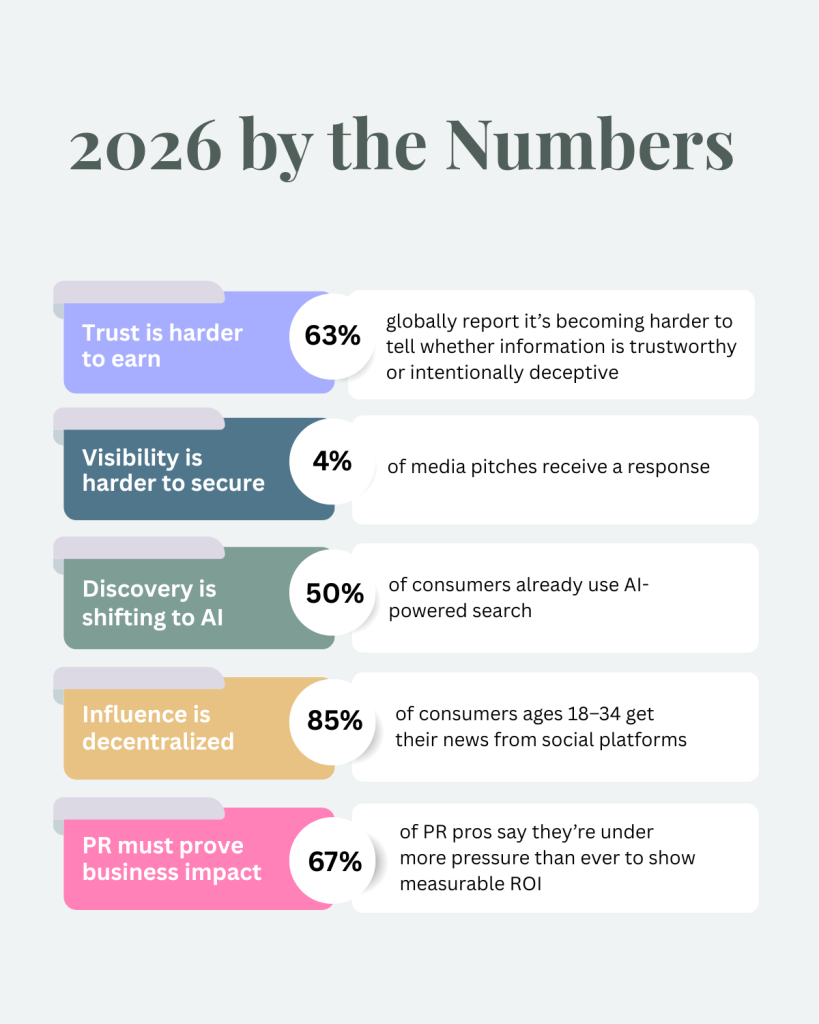
Trust is no longer assumed. In fact, 63% of people globally say it’s becoming harder to tell whether information comes from a respected source or someone trying to deceive them, according to the 2025 Edelman Trust Barometer. As a result, audiences now expect accuracy, authority, and consistency across every touchpoint, from earned media to executive commentary, owned content, social platforms, and creator partnerships. Trust is built slowly and reassessed constantly.
Visibility is harder to earn and easier to lose.
Journalists and consumers are overwhelmed with information. Journalists respond to only 4% of pitches, according to Propel’s Q3 2025 Media Barometer. And the average consumer’s attention span is down to only 47 seconds. Relevance thresholds are higher, attention is scarce, and stories that are not strategically positioned or reinforced tend to spike briefly and fade. Visibility without structure no longer compounds value.
Discovery has moved from clicks to answers.
Increasingly, people encounter brands through AI-generated summaries, search results, and secondhand interpretation rather than direct engagement. According to a 2025 McKinsey study, half of consumers already use AI-powered search today, and it stands to impact $750 billion in revenue by 2028. If stories are not clearly structured, credible, and easy to interpret, brands risk being absent or misunderstood at critical moments of discovery.
Influence is decentralized.
Trust is shaped by many voices: executives, employees, creators, experts, and communities. No single channel or spokesperson carries the full weight of credibility. Consider this: 85% of 18–34 year olds and 67% of 35–54 year olds get their news from social platforms. Communications now live across a distributed ecosystem, whether brands actively manage it or not.
Communications now live across a distributed ecosystem, whether brands actively manage it or not.
Communications teams are under pressure to prove impact.
Visibility alone is no longer the goal. Communications and marketing leaders are expected to support growth, reputation, and revenue. 67% of PR pros believe producing measurable results is the top priority when it comes to showing leadership and clients the value of PR, according to Muck Rack’s State of PR 2025 study. Leadership wants clarity on what this work is driving, how it aligns to business goals, and why it matters.
The Cost of Standing Still
When communications strategies fail to evolve, the outcomes are predictable:
- Visibility that spikes, then disappears
- Brands do not show up in AI-driven discovery
- Creator and influencer programs that prioritize reach without protecting credibility
- Content ecosystems that fail to convert trust into growth
- Efforts that cannot be clearly defended in the boardroom
The work may look busy, but it is not compounding value.
A Reset Worth Taking
The brands that will succeed in 2026 are not chasing more coverage or more content. They are rethinking how communications and marketing work together to drive visibility, credibility, and growth. The reset is not about doing more. It is about doing the work differently.
In practice, this reset shows up in a few clear ways:
- Treating earned media as infrastructure, not the finish line.
Coverage is designed to travel further, live longer, and reinforce a cohesive narrative across owned channels, leadership visibility, creator partnerships, and internal storytelling. - Aligning teams around a shared point of view.
PR, digital, social, and leadership communications operate from the same strategic foundation so trust compounds over time instead of fragmenting across disconnected efforts. - Building stories for modern discovery.
Communications are clear, credible, and structured to hold up wherever they surface, whether in search results, AI-generated summaries, media coverage, sales conversations, or social feeds. - Scaling influence without eroding credibility.
Creator, expert, and leadership visibility programs prioritize expertise, transparency, and genuine alignment, not just audience size. - Measuring what actually matters.
Success moves beyond volume toward indicators that connect reputation strength, trust signals, and contribution to business outcomes.
PR still matters. Marketing still matters. Storytelling still matters. But without structure and alignment, those efforts no longer compound.
This is the shift we consistently see separating brands that build lasting credibility from those chasing moments of attention. The brands that get this right will not just stay visible. They will stay credible, relevant, and positioned for growth.
If this resonates, we’d love to hear what you’re thinking about as you plan for 2026. These are areas where CBC is often helping teams think through what’s next. Get in touch.
About the Author

Whitney Langmaid is a Vice President at CBC, helping brands turn positioning into integrated earned-and-owned storytelling that scales trust and performance across audiences and algorithms. Connect with Whitney on LinkedIn.
FAQ
Traditional PR still matters, but today’s landscape demands an integrated approach. According to the 2025 Edelman Trust Barometer, 63% of people globally find it harder to identify trusted information sources. Modern communications requires coordinated efforts across earned media, owned channels, leadership visibility, and creator partnerships—with trust built slowly and reassessed constantly across every touchpoint.
A system-driven strategy treats communications as connected infrastructure where earned media, owned content, leadership visibility, and creator partnerships reinforce one another over time. Reactive strategies operate campaign-to-campaign without alignment, causing efforts to spike briefly then fade. System-driven approaches compound trust and visibility by maintaining narrative consistency across channels.
Modern measurement must connect to business outcomes leadership cares about. Rather than focusing solely on volume metrics like impressions or clip counts, teams should track reputation strength, trust signals, discovery performance (how brands appear in AI summaries and search), narrative consistency across channels, and direct contribution to pipeline, revenue, or retention. Sixty-seven percent of PR professionals believe producing measurable results is the top priority for demonstrating value, according to Muck Rack’s State of PR 2025 study.